Last updated: February 20, 2026
Roland FP-30X
Great Features, But Action Runs Heavy
The FP-30X packs 256-note polyphony, Bluetooth Audio + MIDI, and the SuperNATURAL piano engine into a solid package. But the PHA-4 key action weighs in at roughly 64g downweight - noticeably heavier than the 50-55g range of most acoustic pianos - which can build habits that don't transfer well.
- 88 PHA-4 keys with escapement
- 256-note polyphony
- Bluetooth Audio + MIDI
- SuperNATURAL piano engine
- 56 voices
- Dual headphone jacks
- 22W speaker system (2x11W)
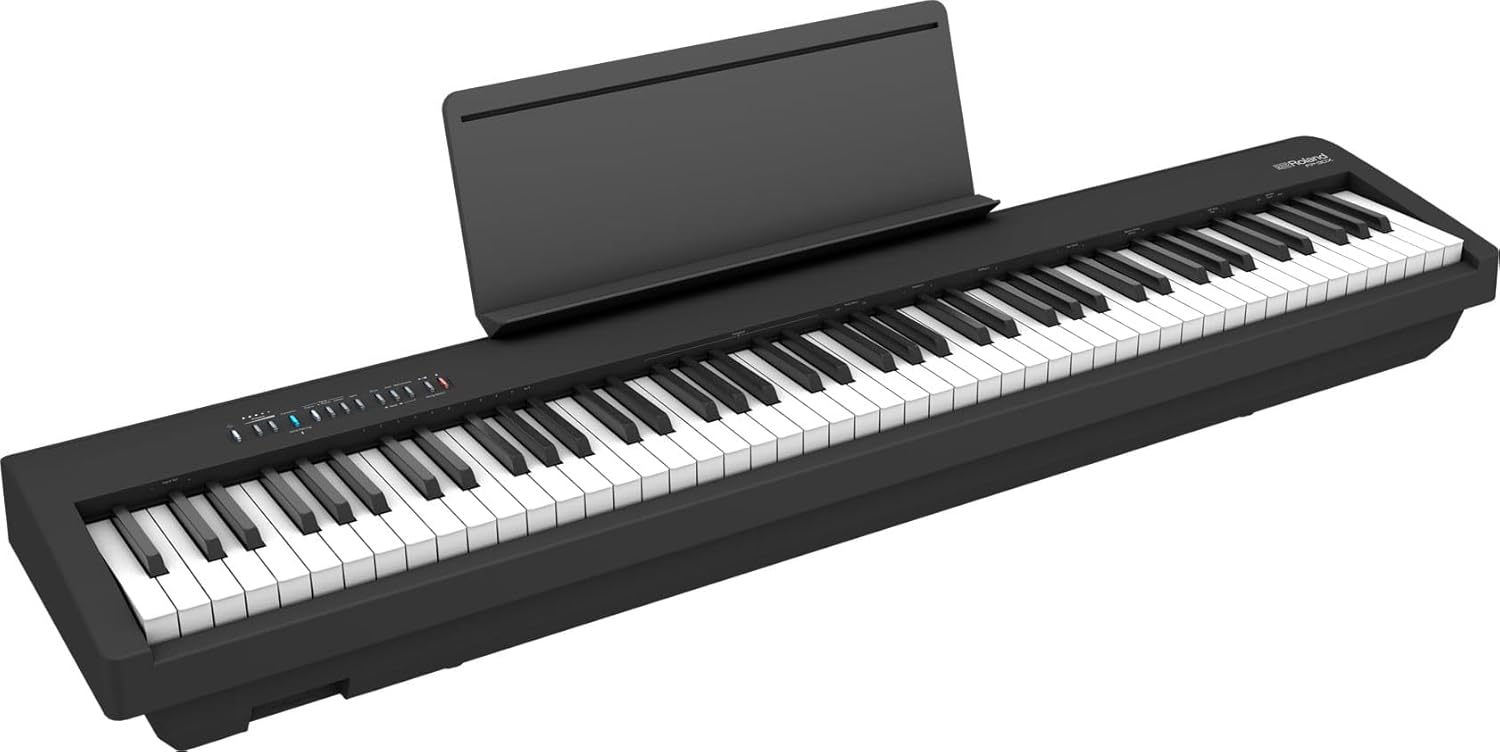
The Roland FP-30X (~$699) has class-leading 256-note polyphony, Bluetooth Audio + MIDI, and Roland’s expressive SuperNATURAL piano engine. But after extended use with students, I’ve found that the key action runs significantly heavier than an acoustic piano (~64g vs 50-55g), and the stretch tuning can sound off in the upper registers. It’s still a capable instrument – but the Yamaha P-225 ($699) is now my top recommendation in this price range.
I used to recommend the Roland FP-30X more than any other digital piano. It had everything: great features, reliable build, the highest polyphony in its class. But after putting more students in front of it over the past year and watching them move between this piano and acoustic instruments, I’ve had to revise my assessment.
The FP-30X is still a good piano. But it has some real issues that I can’t overlook anymore.
Sound Quality
Roland’s SuperNATURAL piano engine is genuinely impressive. Unlike traditional sample-based engines that play back recordings of individual notes, SuperNATURAL models the behavior of an acoustic piano in real time. Press a key softly and the tone is warm, rounded, breathy. Press hard and it opens up with overtones, bite, and projection. The transition between dynamics feels organic in a way that sampled instruments sometimes don’t.
The main concert grand voice is rich and convincing through headphones. Through the built-in 22W speakers, it fills a room better than any competitor in this price range.
However, there’s a tuning issue I need to flag. Roland uses stretch tuning in the upper registers – this is standard on acoustic pianos, but the FP-30X’s implementation can sound slightly off, particularly on high notes. It’s subtle, but once you notice it, you can’t un-hear it. The Yamaha P-225’s CFX sampling with VRM modeling sounds more natural in the top two octaves.
The 56 voices include solid electric pianos, organs, and strings. The electric pianos are particularly good. But the acoustic piano tone – while expressive and dynamic – doesn’t quite match Yamaha’s CFX sampling for pure realism.
Key Action – The Main Issue
This is where I have to be honest, because the PHA-4 Standard action used to be what I praised most about this piano.
The escapement simulation is still genuinely excellent. It recreates the subtle “notch” you feel when pressing keys slowly on an acoustic grand. The ivory-feel texture prevents slipping. The grading from heavy bass to light treble is smooth. On paper, it’s a premium action.
The problem is weight. The PHA-4 in the FP-30X has a downweight of roughly 64 grams. For context, a well-regulated acoustic grand piano typically falls in the 50-55g range. That means the FP-30X’s keys are significantly heavier than what your fingers will encounter on an acoustic piano.
I used to tell students “give it a week, your fingers will adapt.” And they do adapt – but they adapt to something heavier than what they’ll play on everywhere else. I’ve noticed that students who practice primarily on the FP-30X tend to play with more force than necessary when they sit down at an acoustic piano. They’re overcompensating for resistance that isn’t there.
For a developing student, this matters. The whole point of a digital piano is to prepare you for acoustic instruments. An action that’s 15-20% heavier than an acoustic piano works against that goal.
The Yamaha P-225’s GHC action and the Casio CDP-S160’s Scaled Hammer Action both sit closer to acoustic piano weight, which is why I now recommend them over the Roland for most students.
Features and Connectivity
This is where the FP-30X still shines – arguably the best feature set under $1,000:
- Bluetooth Audio + MIDI: Stream music through the speakers for play-along practice (Audio), and connect wirelessly to apps like Flowkey, Simply Piano, or Roland’s Piano Partner 2 (MIDI). Having both is a real advantage – many competitors offer one or the other.
- 256-note polyphony: The highest in its price class. Play the most sustain-heavy Chopin nocturne or Debussy prelude and you won’t hear notes dropping out. The Yamaha P-225 offers 192, which is fine for most music, but 256 gives complete peace of mind.
- Dual headphone jacks: Plug in a student and teacher simultaneously. Essential for lesson setups, and surprisingly rare under $700.
- USB to Host: Connect to a computer for MIDI recording in any DAW.
- 56 voices: More than you’ll likely use, but the variety is there when you want electric piano, organ, or strings.
What’s missing? There’s no line-in for wired audio playback (Bluetooth handles this wirelessly). There are no built-in rhythms or auto-accompaniment. And there’s no onboard recording, though you can record via USB MIDI to a computer or app.
The interface relies on button combinations rather than a screen or touch panel. It works fine once you learn the shortcuts, but it’s not intuitive out of the box. Keep the manual handy for the first week.
Build Quality and Design
The FP-30X is built like a tank. At 32.6 lbs, it’s the heaviest piano in its price class – and you can feel why. The chassis is solid, the keys don’t wobble, and the whole instrument feels planted on a stand. Roland’s build quality is consistently excellent.
Design-wise, it’s functional rather than flashy. The matte black finish is clean and professional. It’s not going to win design awards like the ultra-slim Casio PX-S1100, but it looks like a serious musical instrument.
The 22W speaker system (2x11W) is the loudest in this price tier. It fills a small to medium room comfortably for practice and casual playing.
Stock Issues
As of early 2026, the FP-30X has been inconsistently available at retailers. Prices have fluctuated and stock comes and goes. This isn’t a dealbreaker if you can find one at $699, but it’s worth noting – especially when the Yamaha P-225 is readily available everywhere.
Who It’s For
- Players who prioritize features over action weight. If you want the best polyphony, Bluetooth Audio + MIDI, and dual headphone jacks in one package, the FP-30X still delivers.
- Gigging musicians on a budget. Solid build, loud speakers, USB and Bluetooth connectivity.
- Players who already have strong technique. If you’ve been playing for years and know what you like, the heavier action may be a personal preference rather than a problem.
Who Should Skip It
- Beginners and developing students. The heavy action can build habits that don’t transfer well to acoustic pianos. The Yamaha P-225 ($699) is a better choice for technique development.
- If you prioritize piano tone, the Yamaha P-225 ($699) has a better acoustic piano sound thanks to CFX sampling and VRM modeling.
- If portability matters, the Casio PX-S1100 ($649) is 8 lbs lighter and dramatically slimmer.
- If you want maximum versatility, the Casio PX-S3100 ($849) offers 700 voices and built-in rhythms.
- 256-note polyphony - highest in its price class
- Bluetooth Audio AND MIDI - both wireless standards covered
- SuperNATURAL engine is deeply expressive and dynamic
- Dual headphone jacks for lesson setups
- Strongest speakers in its class (22W)
- Excellent build quality and Roland reliability
- Escapement simulation is genuinely well done
- Key action runs ~64g - significantly heavier than acoustic pianos (50-55g)
- Stretch tuning sounds off in upper registers
- Heavier than competitors at 32.6 lbs
- Stock availability has been inconsistent
- Interface relies on button combinations (no display)
- No built-in rhythms or accompaniment
- Design is functional rather than elegant
How It Compares
Roland FP-30X vs Yamaha P-225: The FP-30X has higher polyphony (256 vs 192) and Bluetooth MIDI. The P-225 has a better acoustic piano sound (CFX with VRM), more natural key weight, and no stretch tuning issues. For most players – especially beginners – the P-225 is now the better choice. Full breakdown: Roland FP-30X vs Yamaha P-225
Roland FP-30X vs Casio PX-S1100: The FP-30X has higher polyphony (256 vs 192), louder speakers, and more voices. The PX-S1100 is 8 lbs lighter, dramatically slimmer, and has a more modern design with lighter key action.
Roland FP-30X vs Roland FP-10: Same PHA-4 key action (same heavy weight issue), but the FP-30X adds 256-note polyphony (vs 96), Bluetooth Audio (the FP-10 has MIDI only), more voices (56 vs 15), louder speakers (22W vs 12W), and dual headphone jacks.
Roland FP-30X
The FP-30X is still a capable digital piano with the best feature set under $1,000 - the polyphony, Bluetooth implementation, and build quality are all excellent. But the overly heavy key action (~64g vs 50-55g acoustic) and stretch tuning issues mean it's no longer my top recommendation. If features and polyphony are your priorities, it delivers. If you're a beginner or developing student, the Yamaha P-225 ($699) is the better investment in your technique.
Check Current PriceWhere to Buy
The Roland FP-30X typically retails around $699 when in stock. Availability has been inconsistent in 2026.
Check Price on AmazonRelated Guides
- Best Digital Pianos Under $1,000 – See how the FP-30X stacks up
- Best Digital Pianos for Beginners – Our top picks for new players
- Best Digital Pianos Under $500 – Budget alternatives
- Roland FP-30X vs Yamaha P-225 – The most common comparison at this price
- How Much Should You Spend on a Digital Piano?
It’s a capable piano, but the key action runs heavier than acoustic pianos (~64g vs 50-55g), which can build habits that don’t transfer well. For beginners, I now recommend the Yamaha P-225 ($699) or Casio CDP-S160 ($499) instead.
Both share the same PHA-4 action with the same heavy weight issue. The FP-30X adds 256-note polyphony (vs 96), Bluetooth Audio, more voices, louder speakers, and dual headphone jacks. If you’ve decided the Roland action works for you, the FP-30X is the more complete instrument.
For small venues and acoustic sets, yes. The 22W speakers work for intimate settings. For larger venues, connect via USB or Bluetooth to a PA system. The solid build handles transport well.
The FP-30X has higher polyphony (256 vs 192) and Bluetooth MIDI. The P-225 has better acoustic piano tone (CFX with VRM), more natural key weight, and costs $50 more. For most players, the Yamaha P-225 is now the better choice.
Yes – both Bluetooth Audio (stream music through the speakers) and Bluetooth MIDI (connect wirelessly to apps). Having both is a significant advantage over competitors that only offer one or the other.
After more extended use with students, I found that the key action weighs roughly 64g – significantly heavier than the 50-55g range of a well-regulated acoustic piano. Students who practice primarily on the FP-30X tend to play with too much force when they move to acoustic instruments. The stretch tuning in the upper registers also sounds slightly off compared to Yamaha’s CFX sampling. It’s still a good piano, but the Yamaha P-225 is the better choice for most players.